
Math Mantra Nepal – Educational Portal
1. Set Theory
Question 1
Let set \( M = \{s, k, y\} \).
- a) Cardinality of set \( M \): \( n(M) = 3 \)
- b) Subsets of set \( M \):
– Proper subsets: \( \emptyset, \{s\}, \{k\}, \{y\}, \{s, k\}, \{s, y\}, \{k, y\} \)
– Improper subset: \( \{s, k, y\} \) - c) Overlapping set example: Let \( N = \{s, a, m\} \). Since \( M \cap N = \{s\} \neq \emptyset \), it is overlapping.
Question 2
Given (where \( U \) is the counting number less than 10):
- \( U = \{1, 2, 3, 4, 5, 6, 7, 8, 9\} \)
- \( X = \{1, 2, 4, 5\} \)
- \( Y = \{5\} \)
- a) Listing method:
\( U = \{1, 2, 3, 4, 5, 6, 7, 8, 9\} \)
\( X = \{1, 2, 4, 5\} \)
\( Y = \{5\} \) - b) Is Y a subset of X? Give a reason:
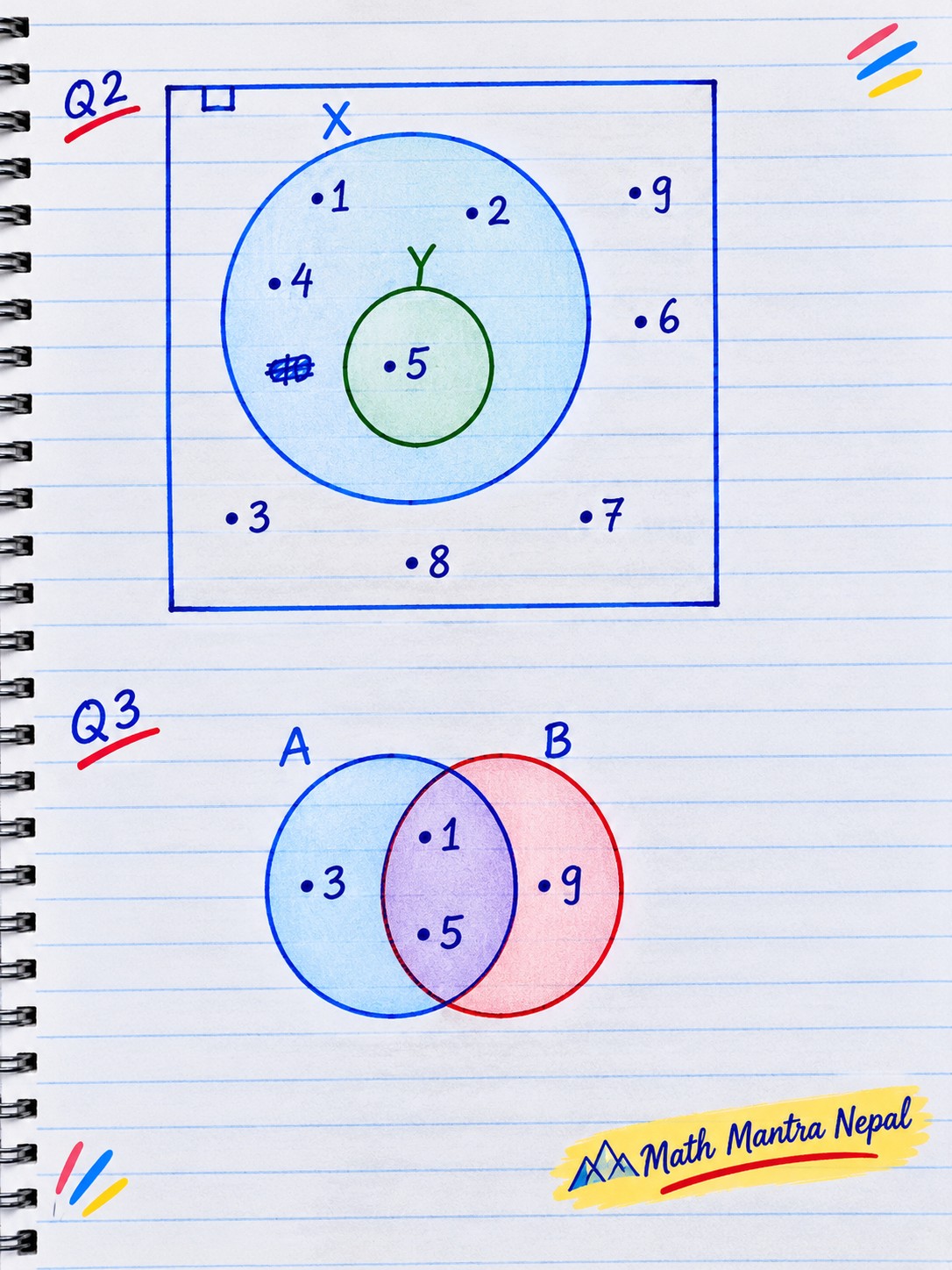
Yes, \( Y \) is a subset of \( X \) because all the elements of set \( Y \) is also present in set \( X \). - c) Represent sets U, X, and Y in a Venn diagram.
- d) Suggest an element that can be removed from set X so that X and Y become disjoint set:
(Hint: element can be kept from universal set only)
Answer: Remove element \( 5 \) from set \( X \) so that \( X \cap Y = \emptyset \) (disjoint sets).
Venn Diagram for Q2(c)
1. Set Theory (Cont.)
Question 3
Given set \( A = \{1, 3, 5\} \) and \( B = \{y \mid y = 2x – 1, x \in A\} = \{1, 5, 9\} \).
- a) Improper subset of A: \( \{1, 3, 5\} \)
- b) Three subsets of B with 2 elements: \( \{1, 5\}, \{1, 9\}, \{5, 9\} \)
- c) Represent set A and B in a Venn diagram.
Venn Diagram for Q3(c)
2. Number Systems & Conversions
Question 4
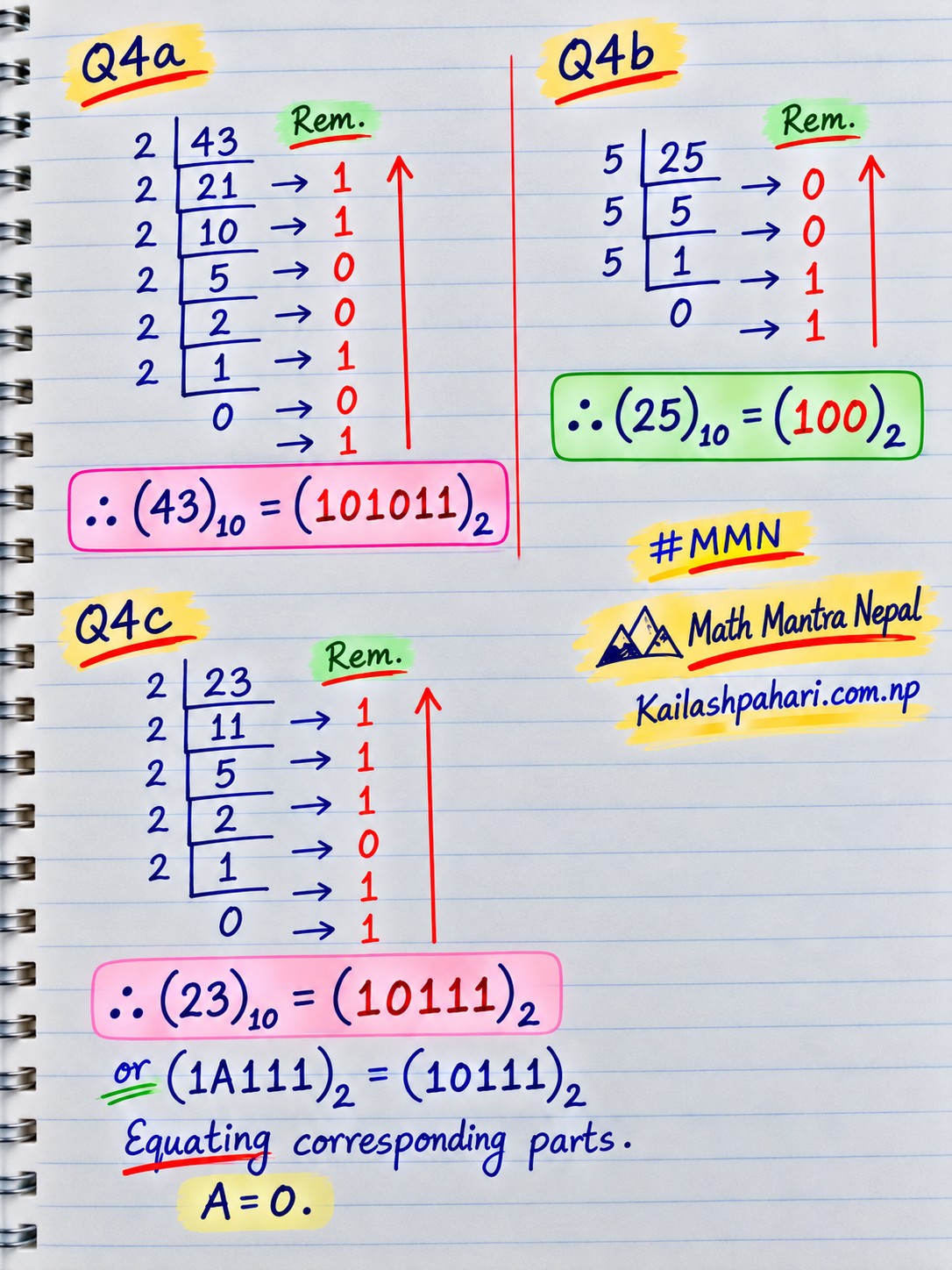
- a) Express 43 into binary number:
\( 43_{10} = 101011_2 \) - b) Express 25 into quinary number system:
\( 25_{10} = 100_5 \) - c) Value of \( A \) in \((1A111)_2 = (23)_{10}\):
\((1 \times 2^4) + (A \times 2^3) + (1 \times 2^2) + (1 \times 2^1) + (1 \times 2^0) = 23\) \(= 16 + 8A + 4 + 2 + 1 = 23\) \(= 23 + 8A = 23\) \(\implies 8A = 23 – 23\) \(\implies 8A = 0 \implies \mathbf{A = 0}\) - d) Express \( 1001_2 \) into decimal:
\((1 \times 2^3) + (0 \times 2^2) + (0 \times 2^1) + (1 \times 2^0)\) \(= 8 + 0 + 0 + 1 = \mathbf{9_{10}}\) - e) Express \( 1100101_2 \) into decimal:
\((1 \times 2^6) + (1 \times 2^5) + (0 \times 2^4) + (0 \times 2^3) + (1 \times 2^2) + (0 \times 2^1) + (1 \times 2^0)\) \(= 64 + 32 + 0 + 0 + 4 + 0 + 1 = \mathbf{101_{10}}\) - f) Express \( 42_5 \) into decimal:
\((4 \times 5^1) + (2 \times 5^0)\) \(= 20 + 2 = \mathbf{22_{10}}\)
Process / Calculation Box
3. Number Line
Question 5: Representation on Number Line
a) Represent \(\sqrt{2}\) on the number line:
Construct a right-angled triangle with base 1 unit and perpendicular 1 unit. Hypotenuse = \(\sqrt{1^2+1^2} = \sqrt{2}\). Mark it with a compass.
Root 2 (\(\sqrt{2}\)) Number Line Video / Short
Click to Play Videob) Represent \(\sqrt{3}\) on the number line:
Using the \(\sqrt{2}\) position as base, construct a perpendicular of 1 unit to get \(\sqrt{3}\).
Root 3 (\(\sqrt{3}\)) Number Line Video / Short
Click to Play Video4 & 5. Decimals & Scientific Notation
Question 6: Recurring Decimals
- a) Convert \( 0.\overline{24} \) into a fraction:
Let \( x = 0.\overline{24} \) \( x = 0.242424\dots \) — (i) Multiplying both sides by 100: \( 100x = 24.242424\dots \) — (ii) Subtracting (i) from (ii): \( 100x – x = 24.2424\dots – 0.2424\dots \) \( 99x = 24 \) \( x = \frac{24}{99} \) \( \mathbf{x = \frac{8}{33}} \) - b) Convert \( 4.\overline{78} \) into a fraction:
Let \( x = 4.\overline{78} \) \( x = 4.787878\dots \) — (i) Multiplying both sides by 100: \( 100x = 478.787878\dots \) — (ii) Subtracting (i) from (ii): \( 100x – x = 478.7878\dots – 4.7878\dots \) \( 99x = 474 \) \( x = \frac{474}{99} \) \( \mathbf{x = \frac{158}{33}} \) - c) Identify whether 3400 is rational or irrational:
\( 3400 = \frac{3400}{1} \) Since it can be expressed in the form \( \frac{p}{q} \), it is a rational number.
Question 7: Scientific Notation & Simplification
- a) Express 3400 into scientific notation:
\( 3400 = 3.4 \times 1000 \) \( \mathbf{= 3.4 \times 10^3} \) - b) Simplify:
\((4.3 \times 10^8) \times (2.0 \times 10^6)\) \(= (4.3 \times 2.0) \times (10^8 \times 10^6)\) \(= 8.6 \times 10^{8+6}\) \(= \mathbf{8.6 \times 10^{14}}\) - c) Simplify:
\(\frac{1.20 \times 10^{-8}}{0.3 \times 10^{-3}}\) \(= \left(\frac{1.20}{0.3}\right) \times \left(\frac{10^{-8}}{10^{-3}}\right)\) \(= 4.0 \times 10^{-8 – (-3)}\) \(= \mathbf{4.0 \times 10^{-5}}\) - d) Simplify \((1.2 \times 10^5) + (5.35 \times 10^6)\):
Method 1 (Using Common Power): \(= (1.2 \times 10^5) + (5.35 \times 10^1 \times 10^5)\) \(= (1.2 \times 10^5) + (53.5 \times 10^5)\) \(= (1.2 + 53.5) \times 10^5\) \(= 54.7 \times 10^5 = \mathbf{5.47 \times 10^6}\)
Method 2 (Using Standard Form & Reconverting): \(= 120000 + 5350000 = 5470000\) \(= \mathbf{5.47 \times 10^6}\) - e) Simplify \((5.35 \times 10^6) – (1.2 \times 10^5)\):
Method 1 (Using Common Power): \(= (5.35 \times 10^1 \times 10^5) – (1.2 \times 10^5)\) \(= (53.5 \times 10^5) – (1.2 \times 10^5)\) \(= (53.5 – 1.2) \times 10^5\) \(= 52.3 \times 10^5 = \mathbf{5.23 \times 10^6}\)
Method 2 (Using Standard Form & Reconverting): \(= 5350000 – 120000 = 5230000\) \(= \mathbf{5.23 \times 10^6}\)
6. Surds & Frequently Asked Questions
- a) \((2 – \sqrt{3})(2 + \sqrt{3})\):
\(= (2)^2 – (\sqrt{3})^2\) \(= 4 – 3 = \mathbf{1}\) - b) \((\sqrt{5} + 2)(\sqrt{5} – 2)\):
\(= (\sqrt{5})^2 – (2)^2\) \(= 5 – 4 = \mathbf{1}\) - c) \(\sqrt{8} \times \sqrt{72}\):
\(= \sqrt{8 \times 72}\) \(= \sqrt{576} = \mathbf{24}\) - d) \(\sqrt[3]{125} + \sqrt{64}\):
\(= \sqrt[3]{5^3} + \sqrt{8^2}\) \(= 5 + 8 = \mathbf{13}\) - e) \(\sqrt{400} – 2\sqrt[3]{343}\):
\(= \sqrt{20^2} – 2\sqrt[3]{7^3}\) \(= 20 – 2(7)\) \(= 20 – 14 = \mathbf{6}\) - f) \(\sqrt[3]{8000} – 2\sqrt{25}\):
\(= \sqrt[3]{20^3} – 2\sqrt{5^2}\) \(= 20 – 2(5)\) \(= 20 – 10 = \mathbf{10}\)
Frequently Asked Questions (FAQ)
1. What is the purpose of this Mathematics Revision portal?
This portal is designed by Math Mantra Nepal to provide step-by-step solutions for important Basic Level Examination (BLE) and grade-level mathematics questions, helping students revise systematically.
2. How should students use these day-wise revision materials?
Students can follow the day-wise structured modules sequentially. By solving these carefully curated questions alongside our integrated video tutorials, learners can thoroughly cover the entire mathematics curriculum step by step.
3. Are these solutions aligned with the official curriculum?
Yes, all the questions and solutions are structured keeping standard school curricula and BLE preparation guidelines in mind to ensure maximum clarity and academic success.