a) Find the ratio of 250 grams and 1 kg. First, convert units into the same form: \( 1 \text{ kg} = 1000 \text{ grams} \)\( \text{Ratio} = \frac{250 \text{ grams}}{1000 \text{ grams}} \)or, \( \text{Ratio} = \frac{250}{1000} \)or, \( \text{Ratio} = \frac{1}{4} \)\( \mathbf{= 1:4} \)
b) Find the ratio of 2000 and 20. \( \text{Ratio} = \frac{2000}{20} \)or, \( \text{Ratio} = \frac{100}{1} \)\( \mathbf{= 100:1} \)
2. Proportions & Applications
a) If \( x:5 = 10:25 \), find the value of x. \( \frac{x}{5} = \frac{10}{25} \)or, \( 25x = 10 \times 5 \)or, \( 25x = 50 \)or, \( x = \frac{50}{25} \)\( \mathbf{x = 2} \)
b) If \( 25:15 = x:3 \), find the value of x. \( \frac{25}{15} = \frac{x}{3} \)or, \( 15 \times x = 25 \times 3 \)or, \( 15x = 75 \)or, \( x = \frac{75}{15} \)\( \mathbf{x = 5} \)
c) What should be subtracted from the numbers 24 and 30 to make the ratio 3:4? Let the number to be subtracted be \( y \).\( \frac{24 – y}{30 – y} = \frac{3}{4} \)or, \( 4(24 – y) = 3(30 – y) \)or, \( 96 – 4y = 90 – 3y \)or, \( 96 – 90 = 4y – 3y \)\( \mathbf{y = 6} \)
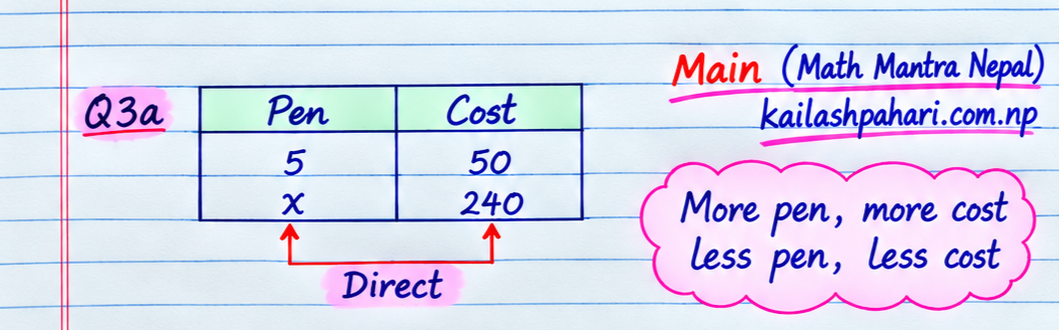
d) If 5 pens are available for Rs. 50, how many more pens are available for Rs. 240? Let the total number of pens for Rs. 240 be \( x \).Since it is direct proportion:
Unitary Method:
– Pens available for Rs. 50 = 5 pens
– Pens available for Rs. 1 = \( \frac{5}{50} \) pens
– Total pens available for Rs. 240 = \( \frac{5}{50} \times 240 = 24 \) pens
– More pens available = \( 24 – 5 = \mathbf{19} \text{ pens} \)
e) Kapila obtains 25, 30, and 75 marks in Nepali, English, and Maths respectively. If the marks she obtained in Nepali, English, Maths, and Science are in proportion, how much did she get in Science? \( \text{Nepali} : \text{English} = \text{Maths} : \text{Science} \)\( 25 : 30 = 75 : x \) (where \( x \) is Science marks)\( \frac{25}{30} = \frac{75}{x} \)or, \( 25 \times x = 30 \times 75 \)or, \( 25x = 2250 \)or, \( x = \frac{2250}{25} \)\( \mathbf{x = 90} \)
f) Mohammad and Abdul had invested in a factory in the ratio of 2:3. If Mohammad has invested Rs. 22,00,000, how much had Abdul invested? Ratio of investment = \( 2:3 \)Mohammad’s investment \( 2x = \text{Rs. } 22,00,000 \)or, \( x = \frac{22,00,000}{2} \)or, \( x = 11,00,000 \)Abdul’s investment = \( 3x = 3 \times 11,00,000 \)\( \mathbf{= \text{Rs. } 33,00,000} \)
g) Chulbul Pandey and Ujjali had invested in a factory in the ratio of 2:3. If the total investment was Rs. 80,00,000, how much had each of them invested? Let Chulbul Pandey’s investment = \( 2x \)Let Ujjali’s investment = \( 3x \)Total investment = \( 80,00,000 \)According to the question,\( 2x + 3x = 80,00,000 \)or, \( 5x = 80,00,000 \)or, \( x = \frac{80,00,000}{5} \)or, \( x = 16,00,000 \)Chulbul Pandey’s investment \( 2x = 2 \times 16,00,000 = \mathbf{\text{Rs. } 32,00,000} \)Ujjali’s investment \( 3x = 3 \times 16,00,000 = \mathbf{\text{Rs. } 48,00,000} \)
Ratio Sum Method:
– Sum of ratio parts = \( 2 + 3 = 5 \)
– Chulbul Pandey’s investment = \( \frac{2}{5} \times 80,00,000 = \mathbf{\text{Rs. } 32,00,000} \)
– Ujjali’s investment = \( \frac{3}{5} \times 80,00,000 = \mathbf{\text{Rs. } 48,00,000} \)
Discount & Profit/Loss
3. Discount & Profit/Loss Applications
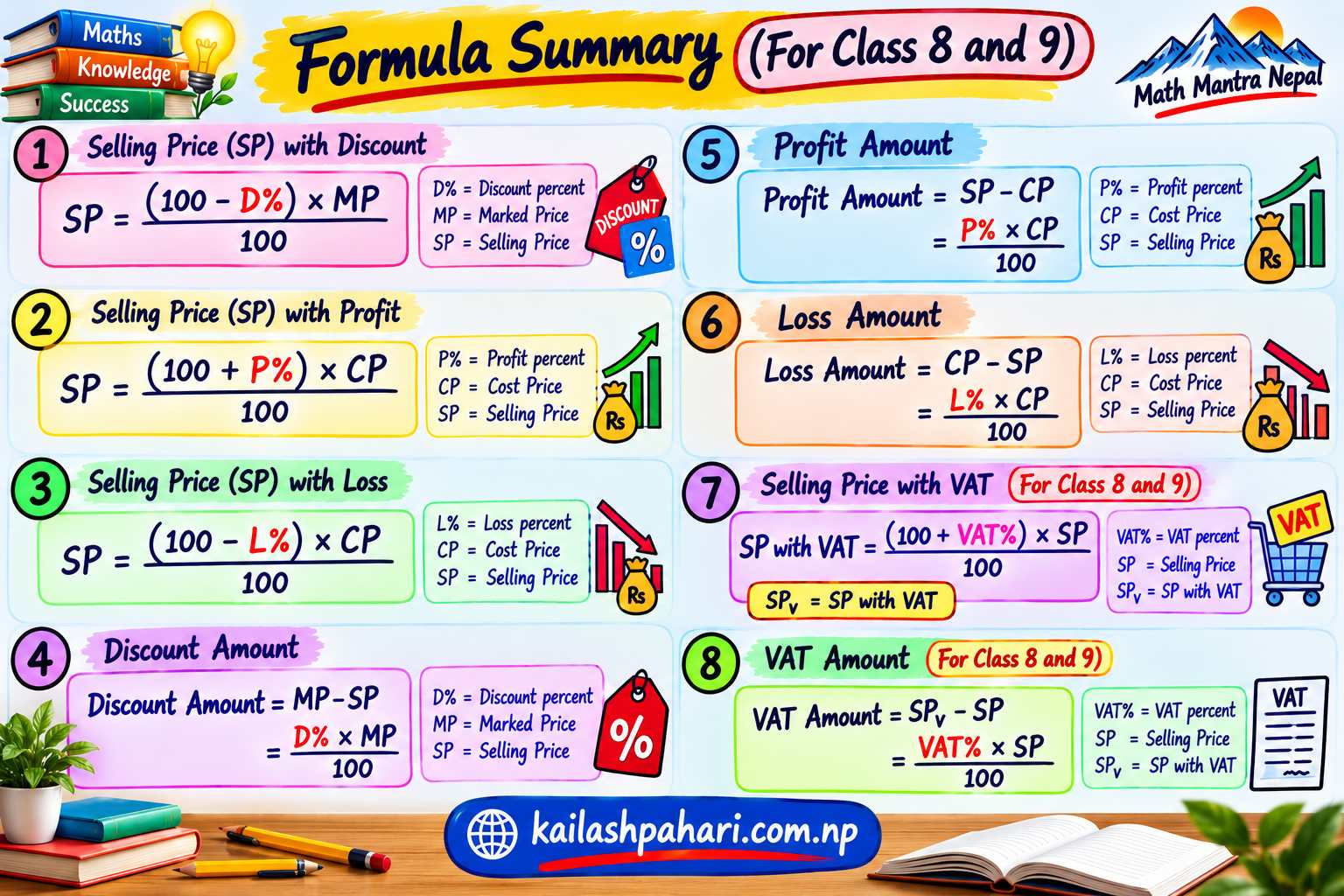
a) If Nabin buys a mobile at an 8% discount and has to pay Rs. 22,080 to the shopkeeper, find the marked price of the mobile. Given, Discount percent \( (d\%) = 8\% \)Selling Price \( (SP) = \text{Rs. } 22,080 \)Marked Price \( (MP) = ? \)We know,\( SP = \frac{(100 – d\%) \times MP}{100} \)or, \( 22080 = \frac{(100 – 8) \times MP}{100} \)or, \( 22080 = \frac{92 \times MP}{100} \)or, \( 22080 \times 100 = 92 \times MP \)or, \( 2208000 = 92MP \)or, \( MP = \frac{2208000}{92} \)\( \mathbf{MP = \text{Rs. } 24,000} \)
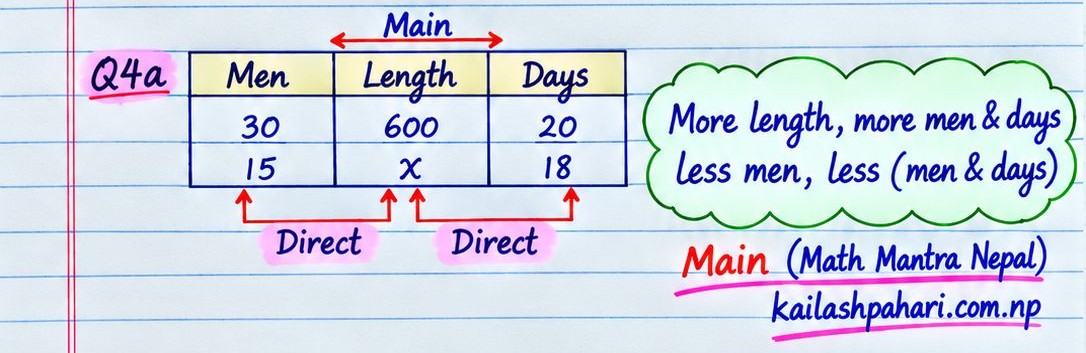
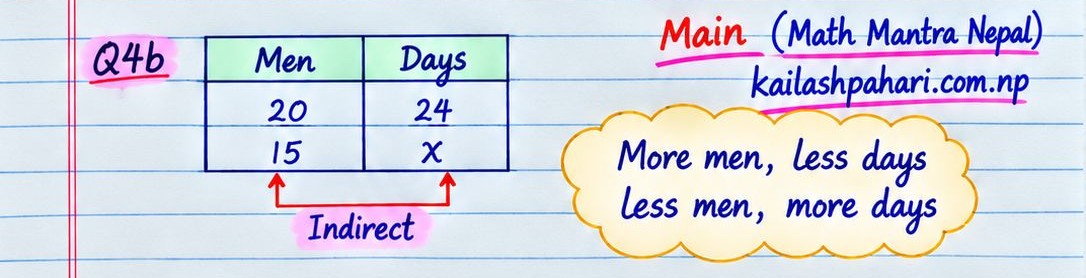
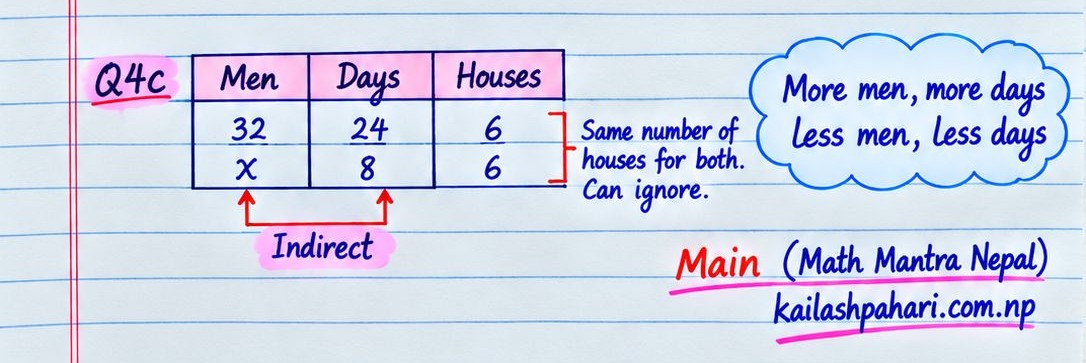
c) 32 people take 24 days to paint 6 houses. If the work is to be completed in 8 days, how many people should be added?
Using Direct and Indirect Proportion formula (Work and Time relationship):\( \frac{M_1 \times D_1}{W_1} = \frac{M_2 \times D_2}{W_2} \)or, \( \frac{32 \times 24}{6} = \frac{M_2 \times 8}{6} \)or, \( \frac{768}{6} = \frac{8M_2}{6} \)or, \( 8M_2 = 768 \)or, \( M_2 = \frac{768}{8} = 96 \text{ total people needed} \)Additional people to be added = \( 96 – 32 = \mathbf{64} \text{ people} \)
5. Simple Interest & Applications
a) If Ram deposits Rs. 5,000 in a bank for 2 years at 8% rate of interest, find meaning, SI, and amount:
Given Data:
– Principal (\( P \)) = Rs. 5,000
– Time (\( T \)) = 2 years
– Rate (\( R \)) = 8% per annum
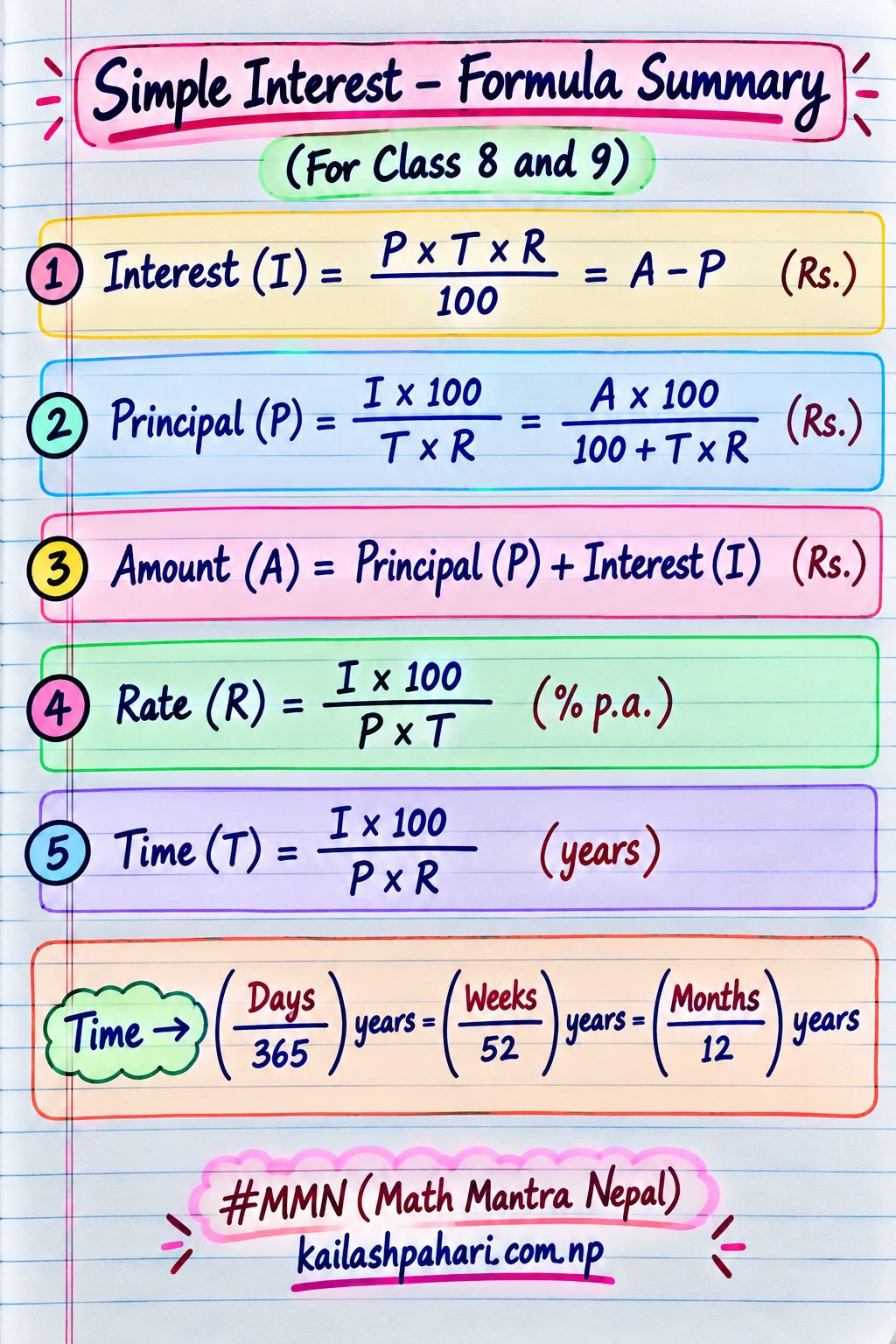
(i) Meaning: It means an interest of Rs. 8 is earned on a principal of Rs. 100 in 1 year.(ii) Simple Interest (SI):\( SI = \frac{P \times T \times R}{100} \)or, \( SI = \frac{5000 \times 2 \times 8}{100} \)\( \mathbf{SI = \text{Rs. } 800} \)(iii) Total Amount:\( A = P + SI \)or, \( A = 5000 + 800 \)\( \mathbf{A = \text{Rs. } 5,800} \)
b) Manjura has to pay Rs. 2,400 as interest at 10% per annum for 3 years. Find principal and amount:
Given Data:
– Simple Interest (\( SI \)) = Rs. 2,400
– Rate (\( R \)) = 10% per annum
– Time (\( T \)) = 3 years
– Principal (\( P \)) = ?
\( SI = \frac{P \times T \times R}{100} \)or, \( 2400 = \frac{P \times 3 \times 10}{100} \)or, \( 2400 = \frac{30P}{100} \)or, \( 30P = 240000 \)or, \( P = \frac{240000}{30} \)\( \mathbf{P = \text{Rs. } 8,000} \)\( A = P + SI \)or, \( A = 8000 + 2400 \)\( \mathbf{A = \text{Rs. } 10,400} \)
c) Santaman took a loan of Rs. 5,000 at 6% per year for 3 years and 6 months. Find total amount:
Given Data:
– Principal (\( P \)) = Rs. 5,000
– Rate (\( R \)) = 6% per annum
– Time (\( T \)) = 3 years 6 months = \( 3 + \frac{6}{12} = 3.5 \text{ years} \)
\( SI = \frac{P \times T \times R}{100} \)or, \( SI = \frac{5000 \times 3.5 \times 6}{100} \)\( \mathbf{SI = \text{Rs. } 1,050} \)\( A = P + SI \)or, \( A = 5000 + 1050 \)\( \mathbf{A = \text{Rs. } 6,050} \)
d) Rohan deposited in banks A and B in ratio 3:2 (A = Rs. 60,000). Find B, interest/amount from B after 2 years at 5%, and time for equal interest:
Given Data:
– Ratio of deposits in Bank A and B = \( 3:2 \)
– Bank A deposit = Rs. 60,000
(i) Deposit in Bank B:Let Bank A deposit = \( 3x \) and Bank B deposit = \( 2x \)or, \( 3x = 60,000 \)or, \( x = \frac{60000}{3} = 20,000 \)Bank B deposit \( = 2x = 2 \times 20,000 = \mathbf{\text{Rs. } 40,000} \)(ii) Interest & Amount from B (for \( P = 40000, T = 2, R = 5\% \)):\( SI = \frac{P \times T \times R}{100} = \frac{40000 \times 2 \times 5}{100} = \mathbf{\text{Rs. } 4,000} \)\( A = P + SI = 40000 + 4000 = \mathbf{\text{Rs. } 44,000} \)(iii) Time for equal interest:Bank A interest \( SI_A = \frac{60000 \times 2 \times 5}{100} = \text{Rs. } 6,000 \)Time for Bank B to earn same interest (Rs. 6,000) with \( P = 40000, R = 5\% \):\( T = \frac{SI \times 100}{P \times R} = \frac{6000 \times 100}{40000 \times 5} = \mathbf{3 \text{ years}} \)
e) Ramesh deposits Rs. 80,000 for 6 years at 10% per annum:
Given Data:
– Principal (\( P \)) = Rs. 80,000
– Total Time (\( T \)) = 6 years
– Rate (\( R \)) = 10% per annum
(i) Interest in 2 years:Here, \( P = 80,000 \), Rate \( R = 10\% \), Time ( \( T = 6 \text{ years} \) ) = 2 years\( SI = \frac{P \times T \times R}{100} \)or, \( SI = \frac{80000 \times 2 \times 10}{100} \)\( \mathbf{SI = \text{Rs. } 16,000} \)(ii) Amount after 2 years & New Principal after withdrawing Rs. 30,000:Amount after 2 years = \( P + SI = 80000 + 16000 = \text{Rs. } 96,000 \)New Principal after withdrawing Rs. 30,000 = Previous Principal + Interest – Withdrawn Amountor, New Principal = \( 80000 + 16000 – 30000 \)\( \mathbf{\text{New Principal} = \text{Rs. } 66,000} \)Remaining Time \( T = 6 – 2 = 4 \text{ years} \)Interest for remaining 4 years = \( \frac{66000 \times 4 \times 10}{100} = \text{Rs. } 26,400 \)Total Amount received after 4 years = New Principal + Interest = \( 66000 + 26400 = \mathbf{\text{Rs. } 92,400} \)(iii) Time to become 3 times:Let Principal \( P = x \), Amount \( A = 3x \)\( SI = A – P = 3x – x = 2x \)Rate \( R = 10\% \)\( T = \frac{SI \times 100}{P \times R} = \frac{2x \times 100}{x \times 10} = \mathbf{20 \text{ years}} \)
Alternative Formula:
\( T = \frac{100(n – 1)}{R} = \frac{100(3 – 1)}{10} = \mathbf{20 \text{ years}} \)
(iv) Expenditure on education and health in ratio 3:2 of Rs. 30,000:Let Expenditure on education = \( 3x \) and Expenditure on health = \( 2x \)According to the question,\( 3x + 2x = 30,000 \)or, \( 5x = 30,000 \)or, \( x = \frac{30000}{5} = 6,000 \)Expenditure on education \( = 3x = 3 \times 6,000 = \mathbf{\text{Rs. } 18,000} \)Expenditure on health \( = 2x = 2 \times 6,000 = \mathbf{\text{Rs. } 12,000} \)
Alternative Method (Direct Proportion):
– Sum of ratio parts = \( 3 + 2 = 5 \)
– Expenditure on education = \( \frac{3}{5} \times 30000 = \mathbf{\text{Rs. } 18,000} \)
– Expenditure on health = \( \frac{2}{5} \times 30000 = \mathbf{\text{Rs. } 12,000} \)
f) Extra Important Question (Finding Principal using Amount, Time, and Rate): Question: How much amount should be deposited by Ram to receive Rs. 13,000 after 3 years at 10% per annum rate of interest?
Given Data:
– Total Amount (\( A \)) = Rs. 13,000
– Time (\( T \)) = 3 years
– Rate (\( R \)) = 10% per annum
– Principal (\( P \)) = ?
We know the formula: \( P = \frac{A \times 100}{100 + T \times R} \)or, \( P = \frac{13000 \times 100}{100 + 3 \times 10} \)or, \( P = \frac{1300000}{100 + 30} \)or, \( P = \frac{1300000}{130} \)\( \mathbf{P = \text{Rs. } 10,000} \)
Self Practice Question for Students:
How much amount should be deposited by Sita to receive Rs. 12,000 after 4 years at 5% per annum rate of interest? [Answer: Rs. 10,000]
g) Extra Important Question (Loan, Rate Calculation & Re-investment): Question: Mr. Dhakal takes a loan of Rs. 80,000 from a bank for 3 years, and he paid Rs. 92,000 to clear the debt. (i) Find the rate of interest per annum.
Given Data:
– Principal (\( P \)) = Rs. 80,000
– Time (\( T \)) = 3 years
– Total Amount Paid (\( A \)) = Rs. 92,000
– Simple Interest (\( SI \)) = \( A – P = 92000 – 80000 = \text{Rs. } 12,000 \)
– Rate (\( R \)) = ?
\( R = \frac{SI \times 100}{P \times T} \)or, \( R = \frac{12000 \times 100}{80000 \times 3} \)or, \( R = \frac{1200000}{240000} \)\( \mathbf{R = 5\% \text{ per annum}} \) (ii) If Mr. Dhakal lends Rs. 50,000 to his friend at the same rate of interest for 2 years, how much interest will he receive?
Given Data for Friend’s Loan:
– Principal (\( P \)) = Rs. 50,000
– Rate (\( R \)) = 5% per annum
– Time (\( T \)) = 2 years
– Simple Interest (\( SI \)) = ?
\( SI = \frac{P \times T \times R}{100} \)or, \( SI = \frac{50000 \times 2 \times 5}{100} \)\( \mathbf{SI = \text{Rs. } 5,000} \)
Extra Practice Question for Students:
Sita takes a loan of Rs. 60,000 for 4 years and pays Rs. 78,000 to clear the loan. (a) Find the rate of interest. (b) If she invests Rs. 30,000 at the same rate for 3 years, find the interest she gets. [Answers: (a) R = 7.5%, (b) SI = Rs. 6,750]